vSAN 6.7 Update 3 Technology Overview

vSAN 6.7 Update 3 Technology Overview
This video focusses on the technical features and capabilities of vSAN 6.7 Update 3
vSAN 6.7 Update 3 Technology Overview
This video focusses on the technical features and capabilities of vSAN 6.7 Update 3
vSAN 6.7 Update 3 – What’s New
VMware vSAN continues to be the Hyperconverged Infrastructure (HCI) market leader. vSAN has proven to be a great fit for all types of workloads, with over 20,000 customers. Traditional applications like Microsoft SQL Server and SAP HANA; next-generation applications like Cassandra, Splunk, and MongoDB; and even container-based services orchestrated through Kubernetes are run on vSAN The post vSAN 6.7 Update 3 – What’s New appeared first on Virtual Blocks.
Announcing vSAN 6.7 Update 3 and Enterprise Plus Edition
vSAN 6.7 Update 3 Integrates Cloud-Native Application Storage Support and More! We’re excited to announce the upcoming release of the industry-leading hyperconverged infrastructure software, VMware vSAN. As applications continue to evolve, the infrastructure needs to be flexible enough to support those changes, and 6.7 Update 3 provides new capabilities to help administrators manage cloud-native applications The post Announcing vSAN 6.7 Update 3 and Enterprise Plus Edition appeared first on…Read More
VMware Cloud Foundation on Dell EMC VxRail Blog Series – part 5: Adding NSX-T
Author: RadhaKrishna Dasari, Staff Solutions Architect. In the previous blog, we discussed Lifecycle Management for Cloud Foundation on VxRail. In this part, we will discuss NSX-T. With the recent release of Cloud Foundation 3.8, customers can deploy Cloud Foundation on VxRail and create workload domains with NSX-T Data Center deployed and pre-configured that comply with the VMware Validated Design (VVD) guidelines. This has been a highly requested feature since The post VMware Cloud…Read More
#vSANChat VMworld – Prepping for VMware’s Biggest Conference
Our recent vSANChat VMworld discussion marks the one year anniversary of vSANChats! A huge shout out to all of our expert attendees and community participants. We’ve had so much fun facilitating these discussions and we’re just getting started. This year we’re heading to San Francisco for another VMworld! Whether you’re a first-time VMworld attendee or The post #vSANChat VMworld – Prepping for VMware’s Biggest Conference appeared first on Virtual Blocks.
How vSAN Simplifies VMware Cloud Foundation
I recently was asked about the operational benefits and cost of ownership of using vSAN with VMware Cloud Foundation. Jeff Hunter posted an excellent blog covering why “VMware Cloud Foundation Starts with vSAN.” Having worked with vSAN in production, it simplified how we provisioned and managed storage. While no single action in standing up a The post How vSAN Simplifies VMware Cloud Foundation appeared first on Virtual Blocks.
VMware Enterprise PKS on VMware vSAN
This solution is a showcase of using VMware vSAN as a platform for deploying VMware Enterprise PKS in a vSphere environment.
vSAN: Building an Efficient Data Center for the Age of Mobility
Companies today rely on business-critical applications and an ever-increasing stream of data to power success. And as workforce mobility becomes a competitive necessity across industries, these applications and their data must be responsive and accessible from any device at any location. That increases the strain on data centers and makes efficiency a priority for overstretched The post vSAN: Building an Efficient Data Center for the Age of Mobility appeared first on Virtual Blocks.
Feature in 5: Cloud Native Storage Beta on vSAN
Welcome to “Featured in Five,” our byte-sized yet expansive explanation of various industry-leading VMware product solutions, all in—you guessed—five short minutes! Last time, we video-profiled Elastic vSAN; in this edition, we turn our attention to Cloud Native Storage Beta on vSAN.
Observing Capacity Changes in vSAN
When defining and applying storage policies to objects in a vSAN cluster, you may notice that some policy definitions will impact the amount of storage capacity consumed by the objects (VMs, VMDKs, etc.) that are assigned the given policy. Let’s explore why this happens, and what to look for in your environment. Policies and their The post Observing Capacity Changes in vSAN appeared first on Virtual Blocks.
vSAN Architecture Components
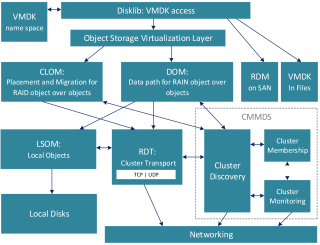
We are going to discuss vSAN architecture components in this post. Generally, vSAN is easy to work with using management tools like vSphere client, Ruby Console or Web client and it simplifies administrative tasks greatly. This is where it is important from a troubleshooting point of view…Read More
Architecting a Hyperconverged Infrastructure for All Your Workloads
Want to learn more about running HCI powered by VMware vSAN? Register for the free webcast now & watch it on demand, at your convenience! You don’t want to miss this one.
Working with vSAN Health Checks
Overview vSAN Health check is a cloud-connected health validation framework. It helps ensure that vSAN is running optimally and configured according to VMware best practices. VMware recommends validating that all health checks are green while deploying production workloads to vSAN. Health checks have varying levels of importance. As an example, a vSAN network partition impacts The post Working with vSAN Health Checks appeared first on Virtual Blocks.
Dell EMC VxRail HCI simplifies cloud adoption
Authorized distributor Drive Control Corporation (DCC) has announced the immediate availability of Dell EMC VxRail HCI appliance to its South African channel partners, supporting organizations’ digital transformation objectives. The announcement also emphasizes Dell EMC’s ongoing commitment to…Read More
Upgrading Large vSAN Clusters
The post, “Multi-Cluster Upgrading Strategies for vSAN” described an approach for upgrading vSAN in a data center comprising of several vSAN clusters. But what about environments running large vSAN clusters? How should an upgrade of a large vSAN cluster be approached? Let’s take a look at this in more detail. Standard vSAN clusters can range The post Upgrading Large vSAN Clusters appeared first on Virtual Blocks.
Why Choose VMware HCI?
There’s a reason VMware leads the hyperconverged infrastructure (HCI) market with over 41% and continues to grow two times faster than our closest competitor. With the most customers in production worldwide, the richest ecosystem in the industry, and the broadest set of deployment options on the market, VMware provides the only enterprise-proven, full HCI stack that puts you on the path to hybrid cloud.Get a Free HCI Assessment
Multi-Cluster Upgrading Strategies for vSAN
Environments consisting of multiple vSAN clusters can take advantage of it’s unique, modular topology by phasing in upgrades on a per-cluster basis to the hypervisor, as well as any dependent hardware updates including storage controllers, NICs, and BIOS versions.
VMware vSAN and Veeam for SAP HANA
Read the Virtual Blocks blog to learn more and start benefiting from selling this joint solution. VMware vSAN and Veeam, both recently certified to run SAP HANA, have partnered to deliver management and operational simplicity, performance with scalability and durability, and deployment flexibility for the most demanding mission-critical workloads. The post VMware vSAN and Veeam for SAP HANA appeared first on Partner News.
VMware keeps the #1 spot in Hyperconverged Infrastructure, According to IDC, vSAN Also Counts Over 20,000 Customers
In their most recent release, IDC’s Converged Systems Tracker for Q1 2019 showed VMware as the market leader with over 41% market share, based on ownership of HCI software. In addition to the IDC data, in our most recent earnings call, VMware announced that over 20,000 organizations have adopted vSAN to power their hyperconverged infrastructure, The post VMware keeps the #1 spot in Hyperconverged Infrastructure, According to IDC, vSAN Also Counts Over 20,000 Customers appeared first on…Read More
How vSAN Reduces Latency and Improves Performance
Inefficiencies within an organization can hinder progress toward an end goal. For Fulton County Schools (FCS), those inefficiencies were three-fold. First, due to the poor performance of critical systems, key tasks took up to 45 minutes to complete. Secondly, traditional SAN solutions caused excessive latency during heavy usage. Finally, in terms of the cost to The post How vSAN Reduces Latency and Improves Performance appeared first on Virtual Blocks.